


"We wanted to keep the door open to whatever adoption
possibilities came up," says Sue, the adoptive mother
of nine-month-old Haly. "We felt we could always
say no later."
Sue* and her husband, Jeff, didn't say no. That's
how they found themselves consoling a tiny, fretful infant
in the neonatal intensive care unit of St. Luke's Hospital
in San Francisco's Mission District.
Haly was born addicted to methadone. Her birthmother
was a heroin addict who checked herself into a methadone
clinic when she discovered she was pregnant. She considered
adoption early in the pregnancy, but didn't make a final
decision until she was in the delivery room. Haly's
birthmom called Adoption Connection from the hospital for
help finding a family for her baby.
One of the leading non-profit adoption agencies in Northern
California, Adoption Connection was ready. "We
give prospective adoptive parents detailed questionnaires,
so we know who is willing to consider adopting a drug-exposed
baby," notes Adoption Connection co-director Lynne Fingerman.
"We're not here to lobby anyone into adopting a baby
who has experienced prenatal exposure to drugs," she
says, "but we are available to help people gather information,
explore their options and decide what they'd like to do."
Sue and Jeff were definitely interested. The call from Adoption Connection
sent them on a research mission. They scanned the Internet, read journal
articles, and talked to neonatalogists and pediatricians. "It was
difficult to find robust information saying that exposure to heroin and methadone
in utero leads to specific long-term consequences," says Sue. "When
Haly's birthmother chose us, we were thrilled."
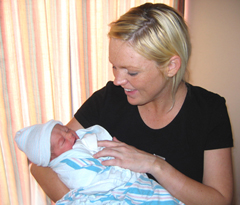
When they went to the hospital to meet Haly, they discovered
a fussy baby in the throws of neonatal methadone withdrawal. "The
nurses said it was like having a bad case of the flu," describes
Sue, who moved into the hospital to give baby Haly huge doses
of TLC. She held her, soothed her, fed her and rocked
her.
Meanwhile the hospital staff administered well-established
protocols for infant methadone withdrawal, including testing
the baby every eight hours to determine the course of the
withdrawal process and giving her small doses of tincture
of opium. It took a full three weeks before Haly's
withdrawal was complete.
"This experience brought out all our instincts for
loving and supporting a vulnerable human being," recalls
Jeff. "The drug-exposure, which was so defining
for those first three weeks, doesn't come up any more. Now,
she's just a normal baby."
Sue and Jeff's experience is not atypical. When prospective
adoptive parents are confronted with the possibility of adopting
an infant or child who has been exposed to drugs, the first
order of business is to research, research and research some
more.
When Micky Duxbury, a marriage and family therapist and
pre-adoption counselor, was working on an adoption for herself
and her partner, she discovered that the birthmother whose
baby they were considering adopting tested positive for amphetamines. That's
when they turned their house into "drug-research central."
After talking to neonatologists and drug specialists, Micky
came to the conclusion that predicting the effects of prenatal
drug exposure is complicated and imprecise. "You
might have a major impact from one use of cocaine that depletes
the baby's oxygen, or you can have 100 uses that have no
impact," she says. "You have to assess each
situation individually."
To do that, you have to find out as much as you can about
which drugs the birthmother used and what her lifestyle was
like. The best approach suggests Micky, is to enlist
a health professional to conduct a good thorough assessment. "This
step might be tricky for adoptive parents because it can
indicate a lack of trust in the birthmother. That's
why it's important to have a neutral professional undertake
this aspect of the process," she notes.
Adoptive parents need to consider the cumulative amounts and overall impact
of the birthmother's drug use. Was she smoking and drinking? Was
she addicted to heroin? How much speed or cocaine did she use? Was
she a recreational user or addicted to her drug of choice? Was she eating
and sleeping, or did her drug use and lifestyle interfere with her nutrition
and rest?
"It's instructive to assess the birthmother's lifestyle," notes
Randie Bencannan, co-director of Adoption Connection. "Is
she always short of money and in crisis? Is she living
with a user? Since most people tend to underreport
their drug use, these soft signs can help adoptive parents
evaluate the situation."
One of the key factors is which drug or drugs the mother
used. Surprisingly, hard drugs like heroin and cocaine
do not present as serious problems for infants as the legal
drugs tobacco and alcohol.
"I'm far more concerned about the negative effects
of alcohol and smoking than I am about heroin," comments
Robert Roth, M.D., the neonatologist who guided baby Haly's
withdrawal. "When people hear cocaine or heroin,
they get very upset, but babies exposed to tobacco can have
serious growth problems, and alcohol has demonstrated and
persistent effects."
Indeed, fetal alcohol syndrome includes well documented
problems, including dysmorphic facial features, mental retardation,
heart problems, and growth and learning difficulties. Every
medical professional contacted for this article considered
alcohol to be the substance that has the most far-reaching,
long-term impact on children's growth and development.
Dr. Roth suggests that parents considering adopting a drug-exposed
infant get a thorough assessment of the baby by a neonatologist – a
pediatrician who specializes in newborn care. Drug
tests for the mother and infant can determine whether a baby
needs to undergo withdrawal. If a medically supervised
withdrawal process is necessary, he encourages adoptive parents
to become actively involved, spending time cuddling and bonding
with the baby.
For babies exposed to cocaine, a renal ultrasound can be
helpful in determining whether the kidneys are properly formed. Whatever
the birthmother's drug use, Dr. Roth recommends having a
free and frank discussion with the doctor caring for the
baby. Doctors working with newborns have seen thousands
of babies, so they have an excellent sense of when something
is physiologically, neurologically or behaviorally off.
Find out whether the baby is crying constantly, sleeping
all the time or moving quickly from deep sleep to agitated
crying. Is the baby interacting appropriately with
caregivers and responding with pleasure to cuddling and soothing?
In recent years there has been quite a shift from the 1980s
media hysteria about crack babies to today's more measured
response to prenatal drug exposure. "Current research
indicates that the outlook for drug-exposed babies is more
positive than it seemed a few years ago, especially for children
who receive good nurturing and care," explains Bencannan.
"There's now a recognition that we were overcalling
the effects of crack-addicted mothers," notes pediatrician
Lane Tanner, M.D., Director of Behavioral and Developmental
Pediatrics at UCSF. "We tell families that the
jury is still out. There is a huge spectrum of effects,
depending on the mother's exposure, her physical health,
the reasons she took drugs, her genetics and the father's
genetics.
"Anecdotally, we hear about children with ADHD, learning
problems, and difficulty organizing themselves and maintaining
focus," he says. "We also hear about children
with the same kinds of exposures who are doing very well."
Indeed, one of the strongest indicators of a positive outcome
is the child's home environment. According to UCSF
genetic counselor Andrea Zanko, a nurturing, stimulating,
stable environment does make a difference in helping children
reach their maximum potential for learning and socializing.
She cautions all parents, adoptive and otherwise, to remember
that every baby born has a three to four percent chance of
having some sort of birth anomaly. "There are
a whole slew of potential causes – infections, drugs,
genetics. Ninety-seven percent of the time everything
is OK, but there is always a risk," she notes.
If problems like developmental delays, learning disabilities,
attentional difficulties, psychological nuances, or changes
in mood or behavior show up, Zanko urges parents to be aggressive
about seeking medical consultation. "There are
lots of programs in the community that support early childhood
development. Take advantage of the resources that are
available," she says.
Ira Chasnoff, M.D., the nation's leading researcher of the
outcomes of children who were prenatally exposed to drugs,
comments that many foster parents and adoptive parents have
gone through long periods with difficult, drug-exposed infants
who have eventually become well-adjusted, lovable children.
In the Spring 1993 issue of The Future of Children, Richard
P. Barth, then at UC Berkeley's School of Social Welfare
and now at the University of North Carolina in Chapel Hill,
noted parents who adopted drug-exposed babies and those who
adopted children with no prenatal exposure to drugs both
reported a high level of satisfaction with their adoptions. There
were also very few reports of differences in behavior and
temperament between the two groups of children two years
after placement.
Bruce and Pat adopted Laura and David from the same birthmother,
who was using methamphetamines when Laura was born four years
ago. She was in jail and drug-free when David was born
six months ago, although she may have been using drugs earlier
in the pregnancy.
"We were certainly concerned about buying into long-term
problems when we considered Laura's adoption," notes
Bruce. "We called the pediatrician and the California
Teratogen Information Service and Clinical Research Program
at UC San Diego. They both gave us the same information – that
methamphetamines don't stay in the system too long."
"We were never aware of any withdrawal, nor have we
observed any hyperactivity. Laura was an easy baby," says
Pat. "At four she's in a French-immersion program
and doing very well."
From an adoptive parent's point of view, it's reassuring
to know that the home environment plays a large role in reversing
the effects of drug exposure. "If you decide to
take the risk, you can make a big difference," comments
Dr. Roth.
"Adopting a drug-exposed baby is not necessarily a
horror story," says Pat. "It can be a very
positive experience."
Tips for those considering adopting a drug-exposed
baby:
- Research, research, research.
- Talk to professionals – pediatricians, neonatologists
or genetic counselors. They can help you feel comfortable
with your decision.
- Enlist a professional who is familiar with substance
abuse to help you determine the birthmother's actual experience
with drugs – which drugs she used, how much and at
what point during the pregnancy.
- Remember that it's often difficult to get a completely
honest history from someone who uses drugs.
Find out as much as you can about the birthmother's lifestyle choices.
- If you are in the midst of discussions with a birthmother
who has already given birth, be sure to talk to the baby's
doctor.
- Have your own physician evaluate any lab reports and
consider getting an ultrasound if the birthmother used
cocaine.
- Ask about the baby's behavior. Is the infant irritable,
fretful and agitated or calm and responsive? Does
she react appropriately to caregivers?
- Remember that every situation is unique, with its own
merits and drawbacks.
- Go into the adoption thinking that some problems might
occur and be ready to deal with them when they do.
- If problems do arise, be aggressive in seeking professional
assessments and help. Early intervention makes a
difference.
- Know that there is no definitive answer to questions
about whether drug-exposed babies grow up predisposed to
use drugs themselves. Parent all children as if they
might be attracted to drugs.
- Remember that environment does make a difference. A
nurturing, stimulating, loving home can make a big difference
in the life of a child who was exposed to drugs.
Resources:
CTIS Pregnancy Risk
Information
California Teratogen Information Service and Clinical Research
Program, UCSD
A statewide program that provides information about prescriptive
an non-prescriptive drugs, street drugs, alcohol, chemicals,
infectious diseases and any other physical agents which may
be harmful to an unborn child. Call: 1 (800) 532-3749.
OTIS: Organization
of Teratology Information Specialists
Teratology Information Services (TIS) are comprehensive and
multidisciplinary resources for medical consultation on prenatal
exposures. TIS interpret information regarding known and potential
reproductive risks into risk assessments that are communicated
to individuals of reproductive age and health care providers.
The
California Teratogen Information Service and Clinical Research
Program at Stanford
Division of Medical Genetics, Department of Pediatrics, Stanford
University School of Medicine. "A community program for
the elimination of preventable birth defects." Call:
1 (800) 532-3749
*Some of the names in this article have been changed
in order to preserve privacy.
©1998. Adoption Connection. All Rights Reserved.
« Back to Newsletter
Archive |
